DAILY WALKING · 7 min read
10,000 steps a day: what it means and how to build the habit
It is the most famous number in walking, and a little misunderstood. Here is where it comes from, what the research says, and how to walk more without forcing it.
Published · Zenbyte

Photo from Wikimedia Commons (public domain): Gryffindor. Credits
Ten thousand steps is a round, friendly target, and millions of people use it every day. But it did not come from a laboratory. Knowing its story makes it easier to use well: as a direction, not a verdict.
Where the number comes from
In the 1960s, a Japanese pedometer went on sale under the name manpo-kei, which means "10,000 step meter". The name was catchy, the number stuck, and it travelled around the world. It was a marketing choice, not the result of a study.
What the research says
Researchers have since looked hard at how daily steps relate to health. One large review, a 2022 meta-analysis in The Lancet Public Health that pooled 15 groups of adults, found that people who took more steps a day had a lower risk of dying early. The benefit grew with more steps, then levelled off:
- for adults aged 60 and over, at around 6,000 to 8,000 steps a day;
- for younger adults, at around 8,000 to 10,000 steps a day.
So 10,000 is not magic, and it is not wrong either. For many adults it sits close to where the benefit flattens out. The biggest gains come at the start, moving from very few steps to a moderate number.
The World Health Organization speaks in minutes instead: 150 to 300 minutes of moderate activity a week for adults. A brisk walk counts. That is roughly 20 to 45 minutes a day.
What 10,000 steps looks like
Depending on your stride, 10,000 steps is roughly 7 to 8 km: about one and a half to two hours of walking in total. Put another way, every ten minutes of steady walking adds around a thousand steps.
Nobody needs to do it in one go. Steps from the school run, the shops and the stairs all count. A day built from a short walk in the morning, a walk after lunch and a longer one in the evening gets there without a single "workout".
Steps or minutes? Pace matters too
A step count tells you how much you moved, not how hard. Both matter. A slow stroll around the shops and a brisk walk to the station can show the same number, but only one of them counts as the moderate activity the WHO has in mind.
A simple check is the talk test. At a moderate pace you can hold a conversation, but you would not want to sing. If you can sing, speed up a little. If you cannot finish a sentence, ease off. Try to make some of your daily steps brisk ones: the walk to work, the loop after dinner, the last ten minutes of a longer walk.
Find your own starting point
Before you chase any target, find out where you are. Carry your phone as usual for a week and look at the average, not your best day. That number is your baseline.
Then add about 1,000 steps a day, roughly ten more minutes of walking. Hold it for a week or two, until it feels normal. Then add another thousand. Small steps up beat big jumps that last a fortnight.
Eight ways to build a walking habit
- Attach it to something you already do. After breakfast, after lunch, after the school run. A new habit sticks best to an old one.
- Walk after meals. Ten minutes after dinner is easy to keep and pleasant in every season.
- Make one errand a walking errand. The bakery, the post office, the pharmacy. Leave the car for one trip a day.
- Get off one stop early. Walk the last stretch of your commute.
- Walk and talk. Take phone calls on foot, or turn a meeting into a walk.
- Give walks a reason. A photo theme, a street you have never taken, a coffee at the end. Curiosity is a better motivator than guilt.
- Judge the week, not the day. A rainy Tuesday undoes nothing. Weekly totals show the real trend.
- Keep a record. Seeing your walks add up is quietly motivating. So is looking back at where you went.

Photo from Wikimedia Commons (CC0): August Dominus. Credits
Count steps without thinking about it
A good step counter does the counting so you can do the walking. In forWalking, the Today view works as a pedometer: your steps for the day against a goal you set, with distance, energy and walking time underneath. A home screen widget shows the same at a glance.
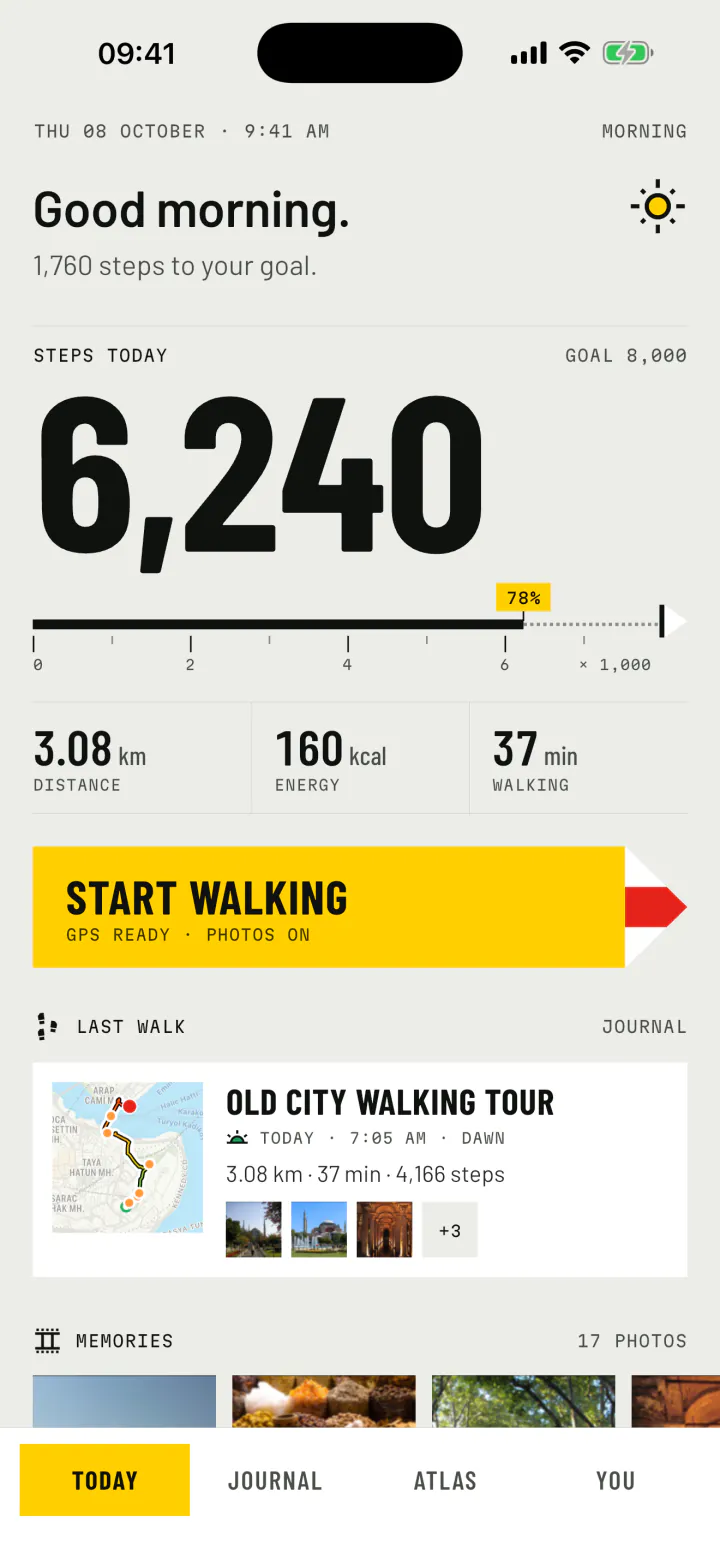
When you head out for a proper walk, record it. The route is drawn on a real map, and the trail report gives you distance, moving time, pace, steps and calories, worked out from your body weight and your speed. The journal keeps your days and weeks, with personal records for the longest walk, the most steps and the longest time.
Two details keep the count honest. A car, a ferry or a plane is told apart from walking on its own, and you can mark a bus or a train yourself, so a ride never pads your numbers. And the walk keeps recording with the screen locked, so the phone can stay in your pocket.
Step counterToday, the journal and your recordsThe short version
- 10,000 steps began as a pedometer's name, not a prescription.
- Research suggests the benefit levels off around 6,000 to 8,000 steps for adults 60 and over, and 8,000 to 10,000 for younger adults.
- The biggest gain is getting started. Add about 1,000 steps at a time.
- Make walking part of your day, not an extra task.
Looking for a reason to walk further? Try a photo walk, or plan a self-guided walking tour of your own city. More on forWalking as a walking tracker.


forWalking: Tours Map Photos iPhone and Android